What is an LED lamp?
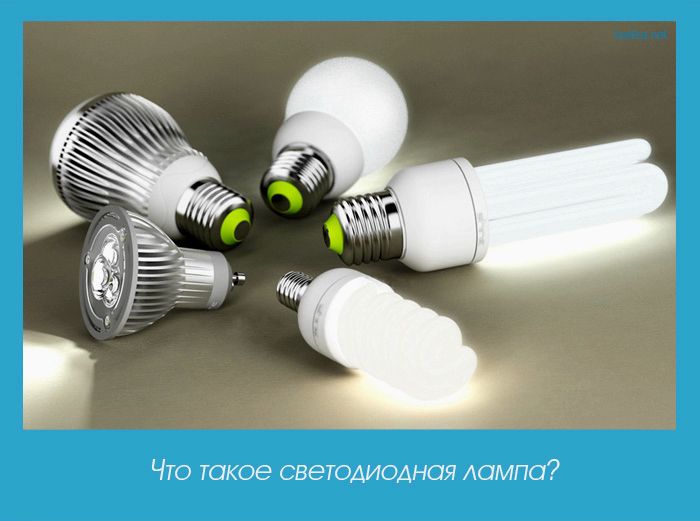
Lamps in which light-emitting diodes (or LED, from the English light-emitting diode) function as a light source are called LED. They are designed to replace all obsolete types of lamps currently used in lighting. Thanks to the use of safe components, LED lamps are in demand in all areas of lighting: household, industrial, street, emergency.
Contents
- What does she look like
- This is what an LED lamp consists of
- Main advantages and disadvantages
What does she look like
The classic LED lamp (sometimes called an LED lamp), like an incandescent lamp, has a pear-shaped shape. Most often, its base part is made of white metal-plastic, and the bulb is a matte plastic hemisphere. This type of LED lamps is available with E14 and E27 sockets, which are most in demand among the population. Nowadays buy LED lamp can be found in any supermarket.
An LED light bulb can have any shape and be made to fit any standard base. For example:
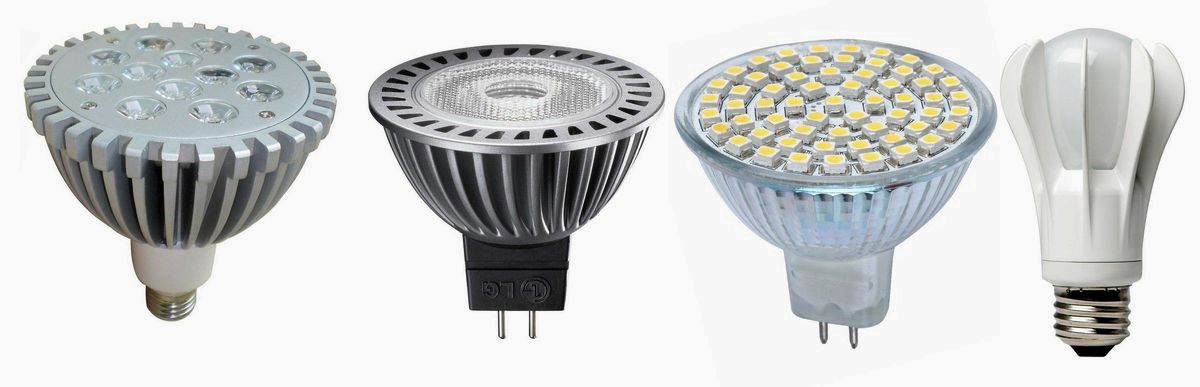
- GU5. 3 – for directional ceiling lamps;
- G4 – for chandeliers and decorative lamps;
- G13 – for replacing linear fluorescent lamps.
More than 90% of LED lamps produced today are assembled on SMD LEDs, which are miniature in size and at the same time have high light output. In addition to them, you can see on sale so-called filament lamps, which outwardly look quite similar to an ordinary incandescent light bulb (IFL). Even less common are light bulbs in which the light source is made in the form of a COB matrix filled with a layer of phosphor. However, in the future it is planned that they will take over the initiative in the production of LED lamps.
This is what an LED lamp consists of
Conventionally, any LED lamp can be represented in the form of component parts: a block with LEDs, a radiator, a light-diffusing cap, a driver unit and a base. The light source is SMD LEDs – located on a PCB board, which is connected to the heatsink through thermal paste (thermal conductive glue). For most 220 V LED lamps, the housing serves as a radiator. It is made of aluminum coated with a thin layer of white plastic. Inside the case there is a driver board designed to convert 220 volt alternating voltage into direct voltage. The output voltage depends on the number and switching circuit of installed LEDs. The driver is connected to the base by wires or through a connector. In order for the light from the bulb to be evenly distributed in all directions, the LEDs are covered with a diffuser bulb, which also serves as protection from mechanical damage.

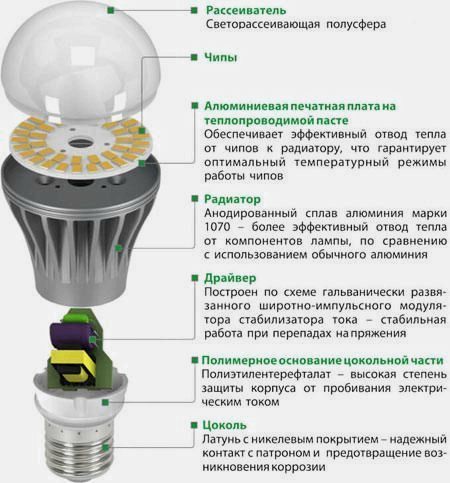
Linear LED lamps of the T8 type are designed in a similar way. They just have a different shape and size of their components. Cheap LED lamps with E14 and E27 sockets may not have a driver unit. Instead, in the center of the board with LEDs, a primitive transformerless power supply is sealed, which does not have current and voltage stabilization. Many miniature LED lamps are assembled in a similar way, since there is not enough space inside their housing to mount the driver.
Main advantages and disadvantages
The constantly growing demand for LED lamps indicates their clear superiority over other artificial light sources. Indeed, if you look at their technical parameters, it becomes clear that fluorescent and spiral lamps are inferior to LED lamps in practice in all respects. And this despite the fact that LED technology continues to improve and has not yet reached its peak. LED lamps really have many advantages:
- The relative luminous efficiency already reaches 30% (theoretical maximum for LEDs is 40%). For fluorescent light sources this figure is 15%, and for LN it does not exceed 3%.
- Low energy consumption (7–9 times less than LN).
- Service life from 10 thousand hours and above. The declared service life of the LN is 1 thousand hours.
- Resistance to mechanical damage and vibration.
- Instant on. Moreover, the number of switchings does not affect the operation of the LEDs.
- The absence of harmful substances, which makes it possible to safely operate and dispose of them.
- Bulbs can be produced in various wattages and with any light color (cool, neutral, warm). And in “smart” LED bulbs, the light color and brightness can be controlled remotely using a phone.
- During operation, the diffuser does not heat up, and the base temperature does not exceed 85°C.
It’s worth acknowledging that LED bulbs are not perfect, which means they have certain disadvantages:
- Relatively high cost. Even though prices have more than halved over the past two years, becoming comparable to those of compact fluorescent bulbs, many people continue to buy these energy-hungry incandescent bulbs out of habit. You can verify that purchasing an LED bulb is completely economically viable by performing simple calculations, which are summarized in a separate article.
- Harmful flickering, invisible to the naked eye, leads to general fatigue and headaches. This drawback is common in inexpensive LED lamps, whose drivers lack current stabilization.
- The need for a step-down converter increases the cost of the product and reduces its reliability.
- LED lamps connected through a backlit switch may flicker or glow dimly when off. This problem can be solved by replacing the switch or modifying the wiring diagram.
- High defect rates, especially among inexpensive LED lamps, are associated with the accelerated production of LED products and the lack of proper quality control at all stages of production.