How to Choose Sliding Gates: Basic Rules and Tips
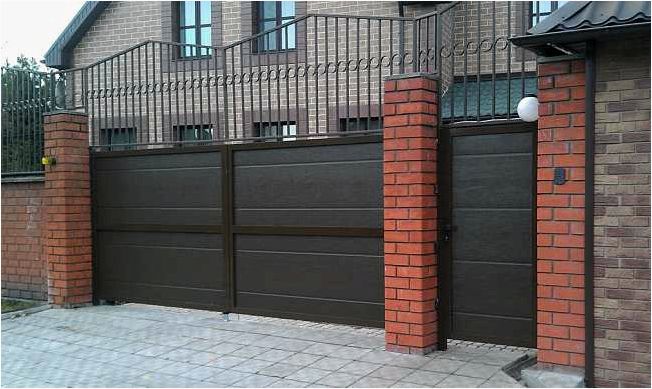
One of the most common misconceptions about gates was that they continue to swing. However, they are gradually being replaced by other design solutions, including sliding wings. Each option has its own characteristics, advantages, disadvantages, capabilities, and limitations. The choice is very difficult: which gate is better – swing or sliding? Consider the characteristics and details of each type of automation.
Article Contents:
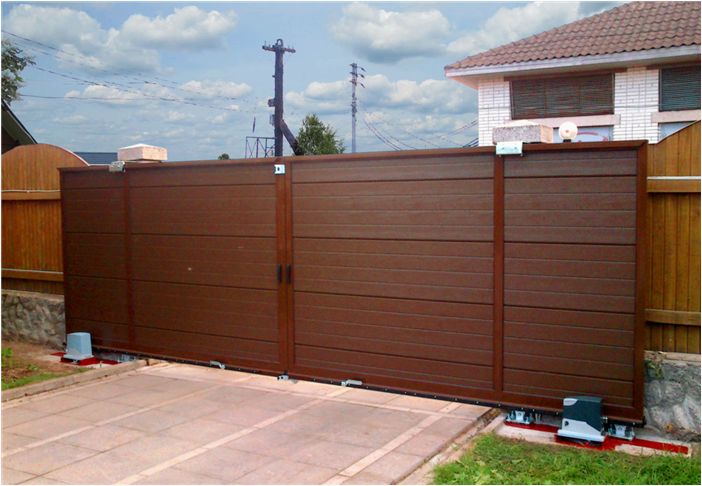
Sliding Gates
The commonality of all sliding gate systems lies in the operating principle – the gate moves through the fence. However, there are several variations within this group. Based on the number of wings, single- and double-wing designs are distinguished, and based on the method of movement, there are three types:
- Track. There are fairly simple devices, as they are relatively inexpensive. The gate rolls along tracks installed on the ground. The only drawback is that the roller channel can become clogged with dirt, snow, or ice, impeding the movement of the gate. Therefore, they are recommended for use in areas with warmer climates. The house has a clear entrance to the property;
- Overhead gates. These gates have been used in some industrial zones and enterprises since Soviet times and have proven their durability. Movement occurs not from below, but from above, where a special beam is installed above the gate. This is a curtain with rollers. The advantages include independence from weather conditions (except for hurricane-force winds), reliability, and a virtually unlimited passage width. The disadvantage is the height limitation. Trucks or minibuses will not be able to pass if overhead gates are installed for passenger cars;
- Cantilever gates. The most expensive, bulky, and at the same time reliable option. The gate leaf is attached to a separate console, not to the support posts. It’s placed on a foundation to withstand the weight of the wings and numerous kicks. The structure consists of two posts and a crossbeam to which the columns are attached. There’s only one major drawback: you need a place to park the gate. If the rollback length is equal to the width of the gate passageway with railings and canopies, the cantilever requires approximately 150-200% of the weight for the door leaf and beam sections.
Advantages of Sliding Gates
This system is becoming increasingly popular. Time has shown that the efforts and funds spent on organizing a trip soon pay off. The advantages of the design include:
- Space optimization. The shutters move along the fence without blocking the view and do not clutter up the area;
- Possibility of diagonal entry (therefore it is recommended to install sliding gates Moscow in narrow alleys where an open door could interfere with traffic);
- Minimal exposure to inclement weather. This is especially important in the harsh Russian winters and treacherous off-season, when frosts and snow melting are frequent;
- Long service life. The weight of the web is distributed throughout the supporting structure, and the rollers ensure uniform movement. Gravity and seasonal soil movements have little effect on the gate, there is no sagging or distortion, and the degree of wear of the elements is much less. All this guarantees a longer service life.
As you know, disadvantages are often a continuation of advantages. Retractable or swing gates are no exception. The disadvantages of the system are precisely related to the design details, and in some cases the positive aspects have opposite negative sides.
Disadvantages of Sliding Gates
- Sliding gates cost 10-20% more than swing gates. This is due to more complex installation, the need to create foundations for load-bearing elements and the higher cost of components (roller carts, fasteners, etc.);
- Large driveways require clear space along the fence that can be accessed for maintenance and repairs. For console solutions, the rollback can be twice as long as the gate. In some cases, to compensate for this inconvenience, the canvas is divided into two parts and moved apart;
- Can only be installed on a flat surface. Variations in the terrain do not allow the laying of rails, which would complicate movement along the console. Hanging gates have a high risk of skewing, which leads to system failure.
Swing Gates
This option is very common in Russia. They are used in private homes, suburban areas and industrial enterprises. Their popularity is due to ease of installation and a variety of decorative finishes. Traditionally, there are several types of swing gates, depending on the number of gates – single-leaf and double-leaf. Due to width restrictions, the first type is used less frequently. The canvas can be regular or folded. The fan design is a little more complicated, but it saves space. The doors can open inward or outward, 90° or completely.

Advantages of Swing Gates:
The most obvious factor is low cost. It is difficult to say that a product is inexpensive, swing or sliding gates, since this is very relative and largely depends on the price of materials and components. However, if we talk about the basic set, then its price is lower than the price of a sliding structure. In addition, they have the following advantages:
- Ease of manufacture. The structure consists of load-bearing columns, hinges and wings. The larger the canvas, the more solid the supporting structure;
- Quick installation. Swing gates do not require the creation of strip foundations and the installation of sliding units. The maximum that is required is to fill the base of the support with concrete for stability;
- Easy repair. There are no complicated parts, so replacing failed elements is easy;
- Possibility of installation on uneven areas.
Another advantage of swing systems is the variety of decorations. Everything is used – cast and artificial structures, wood and its alternatives, lining, corrugated sheets, polymer panels, picket fencing, chain-link.
Disadvantages of Swing Gates:
With all the advantages, there are also significant disadvantages:
- Elimination of harmful weather conditions. Snow drifts often block passages, and navigating through the gates makes them difficult to open and close (compensate for this factor with a lattice-like canvas);
- Requires free space for strokes and limits viewing;
- Quick put on loop. Due to high loads, these parts become covered with microcracks, deform and wear out, requiring regular replacement. Over time, the gate begins to sag and stick;
- Accumulations of snowballs or debris can block the gate opening, so regular cleaning of the surrounding area is necessary.
Features of Automation for Sliding and Swing Gates
There are several differences between automatic sliding and swing gates, which are related to the design of the product. To optimize the process of opening and closing the doors, they are equipped with electric drives, which can be controlled either manually or remotely. The differences between drives for automation of sliding and swing gates are clearly shown in the table.
Swing gate drives
- Linear. Work performed for mechanical or hydraulic rod
- Lever. Acting on the principle of straightening the elbow, the movement towards the goal passes through it.
- Underground. Aesthetically complex, but reliable option. The motor-editor is installed directly under the sash and opens 180°. Due to its high cost, it is rarely used.
Sliding gate drive
- A special device consisting of a gear motor, a built-in control unit, a rack and a remote control. In addition, it can be equipped with motion sensors, photocells and warning lights.
- The drive is installed on the foundation, and the rack is installed on the sash.
From a quantitative point of view, it is recommended to automate the gate valve. Only one motor is required, whereas for swing gates you will have to spend money on two. However, drives for withdrawable systems are more expensive and their integration requires greater investment. So there is parity here and both options are roughly equivalent.
Electric swing or sliding gates are the dream of many homeowners. When installing a drive on a gate, it is important to correctly calculate its power. Always take into account the wind load (50 kg/m2). If the gate leaf weighs 100 kg and its dimensions are 2 x 2 m, then the motor must be rated for a weight of 300 kg, of which 200 kg is the wind load.
There is no single answer to the question of which fence gate is better – retractable or swing. Both systems have their own characteristics and are superior to each other. The Swing wins on price and versatility, but falls short on reliability and durability. Retractable systems save space, but have limited relief. Therefore, when choosing, the main attention should be paid to operating conditions, site features and traffic routes.