Solid board on the floor: pros and cons
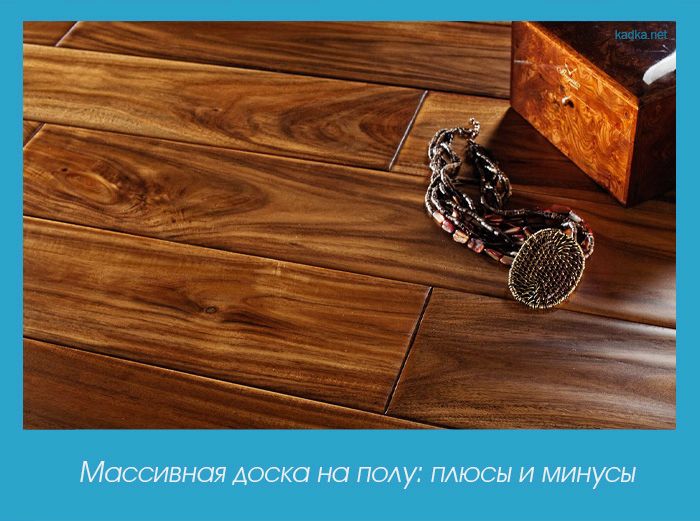
Natural building and finishing materials have been valued at all times. In modern interiors, they are also actively used for covering walls, floors, and structures, as they have high aesthetic properties. However, along with beauty, wood products have unique technical parameters that make their use convenient and practical. A solid board on the floor successfully replaces modern covering materials. In terms of functional and aesthetic properties, it surpasses even the most advanced developments.
General information
A solid board is a piece element for flooring, equipped with a tongue-and-groove locking connection. In terms of external qualities it resembles parquet, but has increased dimensions of one product:
- Width – 10… 20 mm;
- Thickness – 18… 22 mm;
- Length – 1… 2. 5 m, sometimes up to 6 meters.
Solid floor boards are made from solid timber without any additional layers, which makes it an environmentally friendly material.
Production
The production of boards is carried out on special machines by sawing beams of wood, after which grooves and tenons are cut out on the workpiece, then the surface is processed. At some points there may be no locking connections; such elements are mounted using self-tapping screws or glue, but this method is used extremely rarely.
Different production methods allow you to create products of a certain type:
- Radial boards are obtained by radial cutting. This wood has a pleasant, uniform structure with minimal gaps between the rings. High wear resistance, the ability to maintain its parameters over time and low product yield (13-15%) make the cost of such an element high.
- By means of tangential cutting, a select board is obtained. It is distinguished by the presence of a wavy pattern with a small number of small knots of the same color. Solid floor boards produced in a semi-tangential manner are prone to swelling.
- The “natur” type product resembles untreated wood. It is produced in different ways: radial, semi-radial, tangential. The color of such a board is uniform, however, minor differences in tone and the inclusion of knots are allowed without compromising the integrity of the product.
- Rustic is the most uncomplicated type of solid board. It may include significant color differences, large knots, and small cracks. Only mechanical damage that cannot be eliminated by grinding or putty is unacceptable. Such a massive board on the floor looks as natural as possible, but does not last long.
Material
The wood used for production is larch, oak, maple, ash, teak, and merbau. In Russia, the most common products are made from species growing in our regions.

Solid oak floorboards are distinguished by a recognizable pleasant color palette, high strength and minimal wear resistance. This coating can last more than 100 years with proper care.
Solid larch floorboards are affordable and for this reason are very common among consumers. In addition, it has an attractive color and texture; the moisture resistance of the breed makes it possible to use it in rooms with high humidity. With proper care and timely processing, larch coating lasts a long time – up to 100 years or more.
Processing methods
The massive board is laid on the floor in rough form. In production, after the cutting stage, it is processed and decorated in various ways:
- Traditional grinding. This finishing method makes it possible to get rid of surface roughness; the board turns out perfectly smooth with a natural color and pattern.
- The effect of aged wood is achieved by scraping out the top fibers, enhancing the structure of the natural material. For preservation, such a board is coated with a finishing varnish or special oils.
- Tinting the surface of the product helps make the color of the rock deeper or brighter. The color may have a rainbow tint, then the product will be green, red, blue, etc. Often, traditional wood species for our latitudes are given the color of expensive imported varieties, which makes it possible to save on purchases.
- Coating with bronze or brass makes it possible to achieve a metallic effect in different shades, unusual for a natural board. Such solutions are suitable for design interiors in modern and hi-tech styles.
- Brushing with a special brush highlights the texture of the upper layers of wood. Unlike aged boards, such boards have a more pronounced surface and relief.
Advantages and disadvantages
Solid floor boards, of course, have their pros and cons, like any building material. The advantages include:
- Absolutely environmentally friendly. The board is a piece of natural wood with no additional chemical treatment, making it completely harmless to human health and the environment.
- Long service life with proper care.
- Provides a warm floor effect without electric underfloor heating.
- Repairability. The board can be replaced if necessary, and the floor surface can be refinished 5-6 times.
- Exceptional aesthetic appeal due to the choice of patterns, textures, and shades.
Disadvantages:
- Every type of wood is susceptible to deformation due to changes in humidity. During dry summer and winter, the board is minimal in size, but during the humid off-season, it swells.
- Installation of flooring is not easy – there are numerous nuances. Furthermore, the dimensions of the products can create additional challenges. The work should be entrusted to a professional.
All the advantages and disadvantages of solid wood flooring should be considered. These advantages and disadvantages determine the rules for installation and maintenance. By following these guidelines, you can successfully highlight the material’s features and minimize any potential problems.
Solid wood flooring or parquet?
These types of flooring are often confused.
Parquet flooring is a complex element glued together from three layers:
- The top layer is made of wood, often valuable, 3-4 mm thick.
- The middle layer is made of HDF boards or thin softwood planks.
- The bottom layer is made of softwood.
As mentioned, solid wood flooring is made from a single cut. This is the fundamental difference between these products.

In addition, solid wood and parquet flooring differ in cost: the composite product is much cheaper. However, its service life is shorter, and the surface can only be refinished 2-3 times.
Solid wood flooring, however, has the most elegant appearance. The photos clearly demonstrate this. Installation Features
To ensure long-lasting and reliable performance of solid wood flooring, it must be installed correctly. This process is quite labor-intensive, so it’s best to entrust the work to a professional. If you decide to do the renovation yourself, consider a few points:
The surface under the flooring must be perfectly level.
- Regardless of the floor’s design and composition, waterproofing the subfloor and installing a subfloor made of plywood or a joist system are necessary.
- The room’s humidity should be above 60% and the air temperature should be between 10 and 30°C.
- The first board should be installed with the tongue and groove facing the wall.0С.
- An expansion gap must be left along the wall to prevent the floor from swelling as the boards expand.
- These are the key aspects of flooring installation. All aspects and techniques are accessible only to experienced professionals, and it’s still worth consulting them, as the longevity of this type of flooring depends on the quality of installation.
Protection
After installation, the solid wood flooring is sanded with fine sandpaper to remove minor imperfections and snags. If minor damage appears, it must be filled and sanded after drying.
An important step is coating the floor with a polyurethane-acrylic varnish. This will give the board a mirror-like shine and a finished appearance. It’s worth noting that the composition is water-soluble and contains no harmful volatile substances. If the coating dries, another coat should be applied. Furniture can be placed in the room after a week.
In addition to varnish, special oils are used for surface treatment. They don’t produce a glossy, mirror-like effect, but they do impart a shine and natural luster to the surface.
Maintenance
Wood is a delicate material, sensitive to temperature and humidity fluctuations. Therefore, it requires special care to prolong its lifespan and preserve its aesthetic properties:
Maintain a constant humidity of 50-60% in the room to prevent the floor from drying out and swelling.
- The optimal air temperature for the boards is 18-25°C. It should not fluctuate drastically over a short period of time.
- The protective layer should be renewed periodically. Worn coatings (varnish or oil) should be sanded as needed, and the boards should be refinished.0Special care products for solid wood flooring should be used.
- To prevent scratches from furniture and sand, place soft materials under the feet of heavy objects, and lay rugs with a hard backing in the center of the room.
- Vacuum the floor to remove debris. Wiping the planks with a damp cloth is acceptable, but contact with large amounts of water is completely avoided.
- By following these simple rules, you can enjoy your solid wood flooring for many years to come. Contact Villa di Parchetti to purchase solid wood flooring from our website catalog.
- solid, plank, floor, pros, cons
Solid wood flooring: pros and cons Solid wood flooring: pros and cons solid wood flooring: pros and cons