Dimensions, designs and types of door blocks
When carrying out repairs and finishing work on dwellings, it is necessary to install interior and entrance doors. Their functionality and durability depend on the correct selection and installation of door structures. How to choose and install a door block correctly, what exactly to pay attention to during the purchasing process – you will learn in this article.
What is a door block?
In order to decorate the entrance to the rooms, you need a special set of elements.
A door block is a prefabricated door frame (main part), leaves, components for their installation and layout.
Typical door block sizes
Without exception, all door structures must comply with the standard dimensions defined by GOST. Based on the specifics of the apartment project, these parameters may differ. Such dimensions are calculated taking into account the structural features of the walls, fire reliability, but also based on the comfort of use.
Interior door block in width: from 600 for utility and sanitary rooms, 700-800 for bedrooms and kitchens, 1200 – 2000 millimeters (including double doors) for living rooms and large halls.
- The standard thickness of the box is 90-100 millimeters.
- The width of the entrance structure is 800-900 millimeters.
- The permissible height ranges from 2050 to 2400 mm.
Gaps of 10-20 mm must be left between the frame and the wall, and the internal gap between the sash and the frame should be three millimeters. The allowance is made so that there are no complications in use in the event of deformation of the source material, for example, swelling of wood or crumbling of walls.

Elements and designs of door blocks
The door block consists of basic elements, fittings and additional parts.
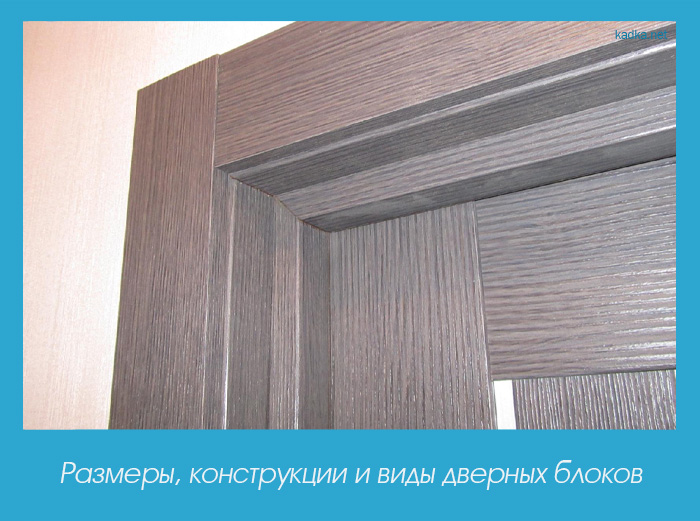
Door frame
The door frame is assembled from a crossbar and two vertical fixed profiles. A sash is installed on one of the side profiles using hinges. The box is often equipped with a threshold and a seal to ensure complete sound and, of course, thermal insulation. Profiles are made from powerful solid wood, spliced timber, and may have a special recess for telescopic trims.
The box comes in:
- with tinting;
- laminated;
- covered with veneer.
Door leaf
A door leaf is a movable element that covers and opens an opening in the wall.
The doors are:
- smooth deaf;
- with cutouts for grilles or glazing;
- finished with panels.
The door leaf is made of composite or solid hardwood, PVC, metal, or veneered MDF. Each material has its own characteristics and is selected based on multifunctional needs. We manufacture ultra-light frames with a honeycomb core or reinforced frames with a solid timber core.
Accessories
Mountings are the parts that cover the border between the door leaf and the frame. They come in two designs:
- telescopic, for fastening to the profile;
- overhead.
Externally:
- semicircular;
- flat.
Extensions cover the joints with the wall and slopes. Special elements are available for non-standard openings and arch designs.
Hardware
Door hardware includes locks, peepholes, opening angle stops, latches, closers, various types of hinges, deadbolts, glass, seals, latches, and handles. The required devices are selected and installed according to their intended purpose. Certain types are required for installation on entrance doors, while others are suitable for interior doors.
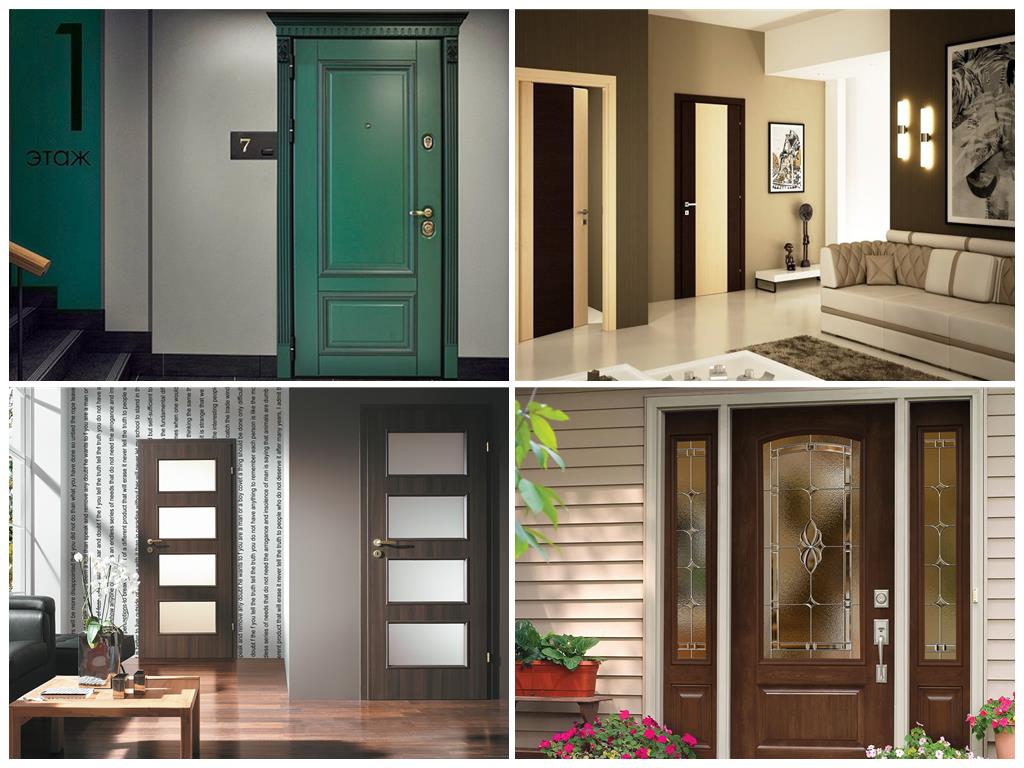
door unit options
When choosing the required design, it’s important to consider the fundamental door variations.
By purpose, they are classified as:
- external (entrance);
- Interior ( Berezovsky interior doors ).
by base material:
- MDF;
- PVC (usually veneered for aesthetic purposes);
- wood (solid or assembled);
- metal.
By number of doors:
- double-leaf (double);
- single (single-leaf);
- one-and-a-half.
By type of device:
- sliding;
- swinging.
By enclosing feature:
- solid;
- with partitions;
- glazed.
To protect the entrance, heavy-duty metal doors with an anti-corrosion coating and insulation are usually used. According to GOST, door units are made of 2mm steel. Technology allows steel structures to be designed in a variety of styles without detracting from the aesthetic appeal. A strong lock, a peephole, and other necessary components can be welded or installed on such doors.
At a minimum, solid wood entrance doors are in demand, as they offer good resistance to corrosion. They are resistant to humidity and temperature fluctuations, have sound insulation, and are highly durable. The advantages of these designs include light weight, a wide range of aesthetic options, and environmental friendliness.
Please note! The selection of interior doors is diverse in all aspects. The cost depends on subsequent maintenance, configuration, material, and installation of all necessary hardware.
The most common type is a multi-purpose swing structure with one leaf. For bedrooms and bathrooms, blank canvases are suitable; doors to the hall or office can be glazed. The convenient one-and-a-half model allows you to use the doors in the usual way, only sometimes expanding the transition using a mini-leaf. Glass panels allow more light into the room, and can be grooved or frosted to maintain privacy in the room.
Sliding structures are placed according to the compartment principle – using a special profile with a gutter or on a roller track.