What is a reefer container?
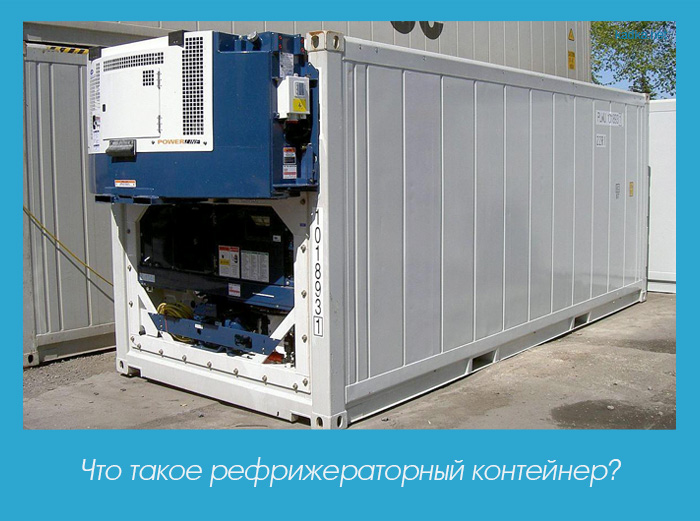
For long-distance transportation, it is very convenient to use specially created cargo units called refrigerated containers. Products with a short shelf life, as well as goods that require storage under certain conditions, retain all their properties during a long journey.
Why do we need refrigerated containers?
Containers can be reused many times because they must be disinfected after the flight. The inner chamber is lined with anti-corrosion alloy sheets or plywood with a water-repellent coating, and the cleaning process is simple. They can transport meat, fish, medicines and other products that require special conditions.
After travel, refrigerators can be used as a stationary refrigerator. They can work both to create sub-zero temperatures and to maintain elevated ambient temperatures, if necessary.
How does a refrigerated container work?
The main materials for the manufacture of containers are aluminum for cladding, stainless steel and polyurethane foam or polyvinyl chloride foam boards of a certain thickness.
Outside refrigerator container 40 feet it is a frame made of aluminum sheets of the rigidity specified by the manufacturer. Its internal part is a refrigerator chamber, the lining of which is made of a layer of heat-insulating polymer (usually polyvinyl chloride foam or polyurethane foam panels).
The walls, floor and ceiling inside are lined with sheets of anti-corrosion alloy or plywood with a water-repellent coating. The floor is made of aluminum profiled sheet, which has the rigidity to support the weight of a warehouse forklift.

The dimensions and external appearance of different models of refrigerated containers may vary slightly depending on the year of production and the manufacturer; there is a classification based on the weight of the stored products.
Loading occurs through a door with an aluminum frame and an inner layer of polymer of the same thickness as on the walls. It has a special lock that guarantees tight storage in the compartment.
When loading, containers are placed on specified pallets that support their weight along with their contents and are located at a certain distance from each other. The location rules provide for certain distances between them; loading takes place according to pre-approved dimensional diagrams. In addition, there are requirements for the distance from the ceiling of the reefer container to the ceiling of the compartment in which it is located. Signal marks are used for visual control of loading.
To maintain the necessary internal conditions inside the box, refrigeration equipment is used: a refrigeration compressor and sensors. The compressor is located at the end of the housing and operates automatically according to a programmed mode. Temperature range fro m-26? C to +25? C. The compressor is powered from a three-phase circuit through which a current flows at a frequency of 50 Hz and a voltage of 340-360 V.
A specialized electronic control unit and sensors ensure that the necessary conditions are maintained inside the storage compartment. They also control the start of defrost cycles, ensuring fully automated storage. The electronic unit detects problems or failures in equipment and units, which allows them to be eliminated immediately, minimizing the risk of product damage.
The air flow into the box is supplied along the floor, along a T-shaped aluminum profile, then rises along the walls to the ceiling. After which it returns to the cooling unit to lower the temperature or heat, depending on the set program. A specialized lock provides an additional guarantee of tightness.
Main types of refrigerated containers
All refrigerated containers can be divided into three types, depending on the method of transportation:
- railway;
- marine;
- automobile.
There are certain standards for all container models in terms of carrying capacity and external dimensions. The three presented types of refrigerated containers differ in the connecting devices to the gripping mechanism of unloading and loading transport. This classification saves time on their transportation and arrangement inside the compartments, and allows for door-to-door delivery.
The railways have the highest rates for the transportation of refrigerated containers, but at the same time they provide delivery of containers up to 8. 5 feet in height and the heaviest weight.
Important characteristics are the internal volumes of the storage, the dimensions of the doorways and the load capacity. All the information necessary about the container is printed on its side wall – these are 6 letters of the Latin alphabet and 11 numbers.
Refrigerated containers are now in demand because their operation does not require specialists, the work is automatic. Cleaning and disinfection also do not require special personnel, and loading is also easy thanks to signal marks. They allow you to transport products without spoiling them over any distance using various modes of transport.