What are paving stones and what types do they come in?
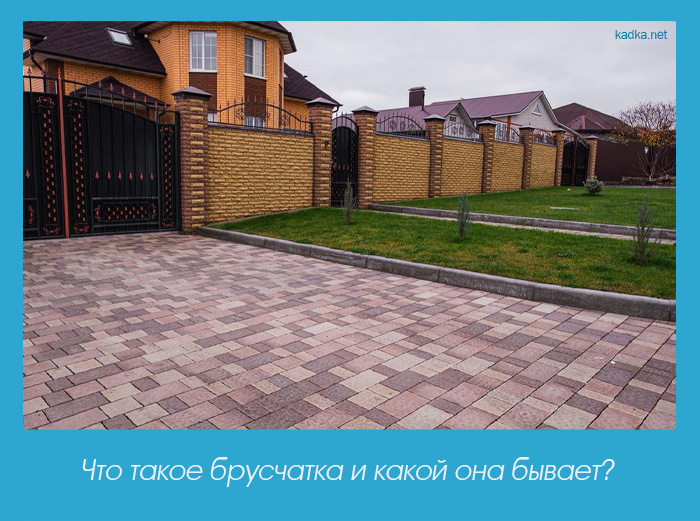
Paving stones are the material that all our ancestors used hundreds of years ago. Of course, technology is improving, and roads are often covered with asphalt. But popularity is returning: roads paved with paving stones are much more reliable and beautiful than their ultra-modern prototype, which reeks of tar.
What are paving stones
By definition, a paving stone is a small parallelepiped of stone that is quite thick. This is done in order to ensure maximum strength of the coating, since the paving stones are laid compactly one to one on the sand embankment. There are several main subtypes of paving stones – sawn and chipped.
- The chipped one is a roughly processed model, whose shape is developed only by eye. Driving on a road paved with crushed paving stones is quite uncomfortable and this is sadly expressed in a car.
- Sawn paving stones are carefully processed stones that, when properly laid, guarantee a smooth surface. It is not inferior to asphalt pavement. Occasionally, such paving stones are even polished on the front side.
- Granite paving stones are one of the most popular and durable materials for construction production.
What is it made from?
Typically, paving stones are made from two types of materials – granite and sandstone. Granite belongs to the group of noble stones. It is aesthetically durable and beautiful, and also gives the road a certain bourgeois taste and style. With it you can achieve beautiful designs on the paths. Sandstone is a layered substance that is significantly lower in cost than granite stone.
However, there are some advantages to using sandstone as a starting material for making paving stones:
- The customer can choose the thickness of the products he requires;
- Wide variety in choosing the configuration of any element – you can create sawn, chipped or even paving stones with rounded edges.
The production of concrete paving stones involves 2 technological schemes: by vibration casting and by vibration pressing. To produce the bulk of the products, vibrocompression itself is used.
Technical parameters and properties
So, paving stones are an excellent material for construction, which has many positive qualities and is ideal for paving roads, but also for decorating summer cottages and garden plots, in this case it is sometimes used base plate op-1k , it is intended for use in the overhaul of wells located within the carriageway of streets and roads of citywide importance.

To this we can only add that it has the following parameters:
- Strength – there are three strength indicators: compressive strength, bending strength and abrasion strength. Compression will be responsible for the load that the paving stones can hold under vertical pressure. A strong, normal starting material contains a strength of about 400 kg/cm2. The bending index shows the maximum load on the paving stones lying unevenly and at an angle. The average coefficient is 60 kg/cm2. The lower the abrasion, the longer the period of use. A suitable coefficient for paving stones is 0. 4 g/cm2;
- Manufacturing technology – these paving stones are made using vibratory casting of concrete and various admixtures (for example, colored pigments and others);
- Frost resistance – this characteristic indicates how many cycles of freezing and thawing the paving stones can withstand. On average, in Russia during the winter period, paving stones will go through 5 – 10 cycles within the freezing limits fro m-20 to +20 0C. That is, its normal service life is 50 years;
- Water absorption function – for paving stones this figure reaches about 2%. What does this mean? If the weight of a stone reaches 1000 g, it is capable of absorbing 20 g of liquid. This is perhaps the greatest weakness of paving stones, since in winter, water that gets into the structure of the stone will thaw and freeze, thereby destroying the natural stone from the inside. In other words, the lower the percentage of water absorption, the better;
- Weight and size – Pavers can come in different weights and sizes. So, on average, a square meter contains a weight of over one hundred kilograms, and the dimensions directly depend on the shape of the components.
Pros and cons, general assessment of paving stones
As a rule, a road paved with paving stones either simply does not have any negative qualities, or they are completely insignificant. Of course, if the specialist who was directly involved in laying out the paving stones made mistakes and the paving stones were not laid out evenly, this could cause some inconvenience to drivers and pedestrians.
But at the same time, the number of positive qualities naturally exceeds the number of disadvantages:
- The appearance of puddles is reduced to a minimum as thawed and waste water seeps through the seams between the luggage.
- The material is environmentally friendly – when heated, it does not release resins or harmful substances into the air, as, for example, when heating asphalt.
- Paving stones are quite practical. For example, they can be easily removed when utility lines are needed.
- A significant advantage of paving stones is their durability, which can last for decades or even hundreds of years.
In summary, it’s safe to say that paving stones have never lost their practicality or relevance, which is why their use remains so practical. Most people prefer paving stones to other surfaces, as evidenced by the countless positive reviews.
Paving stones are a durable, unique, and aesthetically pleasing material for paving roads, sidewalks, and landscaping. They receive a solid A- rating across all criteria and characteristics.